PrepSync Card Library.
Every card you save, and the speech doc you build from them.
Save cards from Search, CardCut, Re-Highlighter and the vaults into one library. Sort them into Verbatim-style files, build your speech doc right next to them, and download it as a Word file when it's time to send.
One place for your evidence. Built for how debaters prep.
The Card Library comes with a PrepSync membership. Save cards from anywhere on PrepSync, then organize them into files and speech docs.
Save from anywhere
One click saves a card from Search, CardCut, Re-Highlighter or the vaults, with its formatting.
Verbatim-style files
Pockets, hats, blocks and tags, with an outline to jump around a long file.
Speech doc and Word download
Build your speech doc next to your files and download it as a .docx to send.
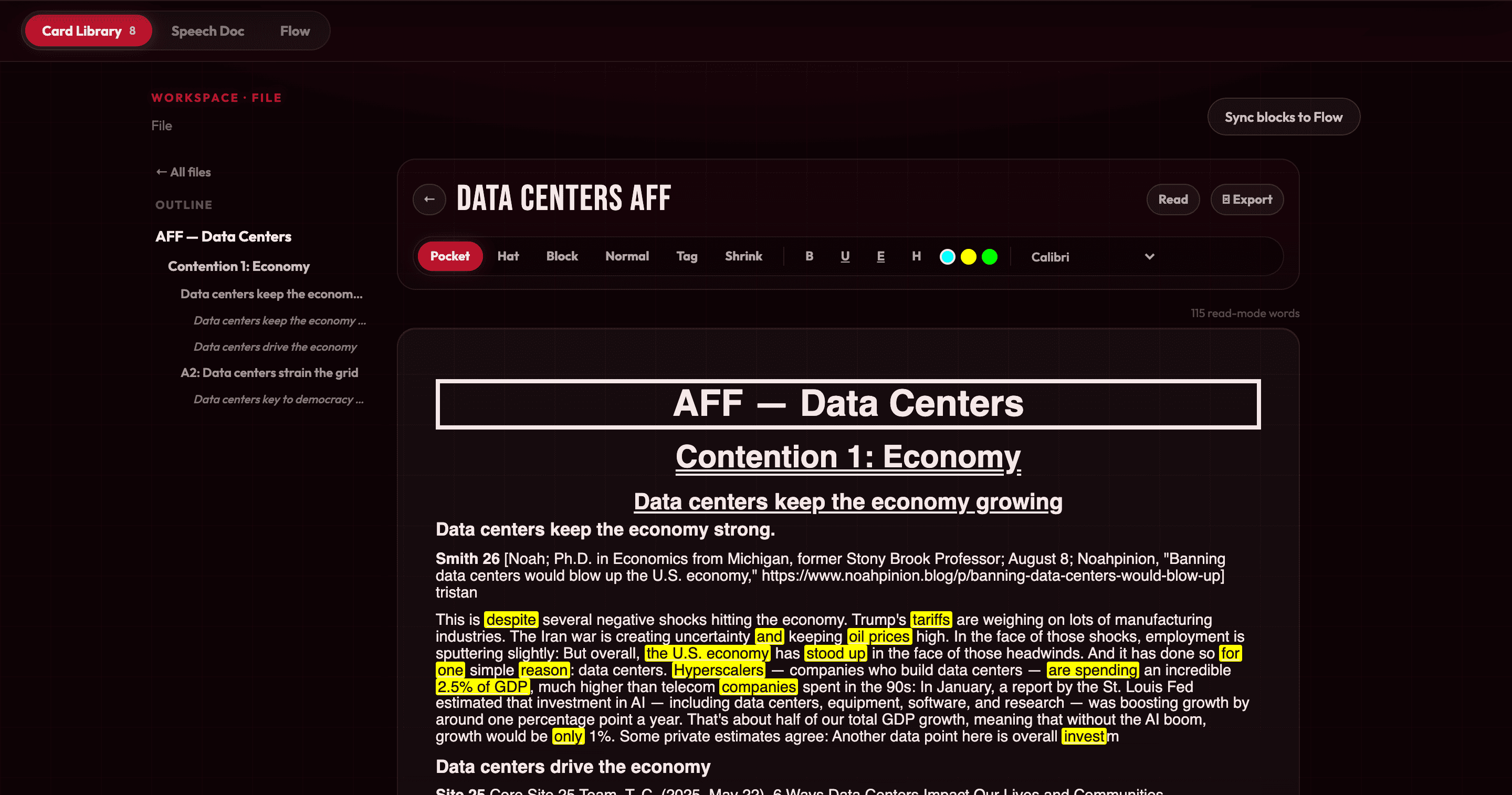
Type a heading on the last line and press Block. Saved cards you add go at the end of the file, under your newest block.
PRO — Blocks
A2: TPNW breaks NATO cohesion
The TPNW makes NATO commitments more credible
Egeland 21 [Egeland 21, postdoctoral researcher and lecturer in international security at the Center for International Studies (Nuclear Knowledges program) at Sciences Po in Paris. He is also a fellow of the Norwegian Academy of International Law in Oslo (Kjølv Egeland, 01/28/2021, "NATO and the Nuclear Weapons Ban Treaty: Options for the Biden Administration," Just Security, https://www.justsecurity.org/74366/nato-and-the-nuclear-weapons-ban-treaty-options-for-the-biden-administration/)]
Support for the TPNW is hardly radical or contrary to support for transatlantic cooperation. A number of former leaders in U.S.-allied nations have come out in favor of the TPNW, including two former NATO secretaries general. Former U.S. Secretary of Defense Bill Perry supports the agreement. According to former U.S. official Lawrence Korb, "If Reagan was still alive, he would be taking a leadership role, along with Pope Francis, in trying to get other nations, especially those with nuclear weapons to ratify the TPNW."The TPNW could even have some benefits for the United States over the long term. The overall aim of the states and organizations backing the TPNW is to weaken the prestige value of nuclear weapons and to over time build pressure for nuclear disarmament through the stigmatization of nuclear arms. On the one hand, such normative entrepreneurship could be interpreted as a long-term challenge to America's strategic autonomy and, ultimately, the credibility of U.S. central deterrence. Evidently, any deterrent threat loses its credibility if its enactment is rendered unacceptable. On the other hand, the United States has repeatedly promised to reduce its reliance on nuclear weapons and to seek their eventual elimination. Owing to America's conventional military superiority, a lower salience of nuclear weapons in global affairs would, all other things being equal, favor the United States.Permitting non-nuclear allies to join the TPNW could also be of considerable value to those in a Biden administration who are eager to promote measures of nuclear restraint such as decreased funding for certain elements of the ongoing nuclear modernization effort, U.S.–Russian negotiations on further nuclear reductions, the phasing out of land-based ICBMs, or a shift to a no-first use or "sole purpose" nuclear posture. At present, the central argument against all of this is that America's allies would never accept it. Indeed, virtually all observers, including industry-aligned hawks, accept that the United States does not need a first-use policy or enormous nuclear arsenal for its own national defense. These instruments are necessary, so goes the argument, to "reassure" unspecified "allies and partners." Non-nuclear allies joining the TPNW would help take the sting out of this often-overegged sales pitch.One more question remains: Would the TPNW effectively outlaw extended nuclear deterrence? While the TPNW does not prohibit the individual or collective use of force by conventional means, parties to the TPNW would be prevented from explicitly calling on the United States or other allies to use nuclear weapons on their behalf, for example in a conflict involving Russia. Yet ever since the 1950s, when the Soviet Union developed long-range nuclear forces capable of doing immeasurable damage to the United States, it has been widely acknowledged that, unless America's own vital national interests or survival were at stake, no U.S. president would authorize use of nuclear arms against Russia. As former national security advisor and Secretary of State Henry Kissinger reportedly put it, "great powers do not commit suicide for their allies." U.S. threats to use nuclear weapons in response to minor conflicts or conventional aggression in Europe are therefore not believable and consequently of little value as deterrents.
TPNW is irrelevant to the NPT or alliance cohesion
Gibbons 17 [Rebecca Davis Gibbons, Ph.D. in Government from Georgetown University, Visiting assistant Bowdoin College, 7-14-2017, "The Nuclear Ban Treaty: How Did We Get Here, What Does it Mean for the United States?," https://warontherocks.com/2017/07/the-nuclear-ban-treaty-how-did-we-get-here-what-does-it-mean-for-the-united-states/]
Looking AheadThe immediate worries about the treaty are unlikely to play out, but in the longer term, this milestone could challenge public perceptions about morality of possessing nuclear weapons.A common criticism of the ban effort is that that the treaty will not result in the elimination of a single nuclear weapon. In the near future, this is correct. Yet this criticism misrepresents the strategy of the nuclear ban campaigners. Advocates envision the treaty as an interim step to nuclear disarmament through its role in delegitimizing nuclear weapons and the doctrines of nuclear deterrence and extended deterrence. With the adoption of a legally binding treaty, negotiated at the United Nations, disarmament advocates will call attention to the illegitimacy of all nuclear weapons-related activities. As Beatrice Fihn, executive director of the International Campaign to Abolish Nuclear Weapons, explained in March, "We will identify what kind of behavior is now illegal, under this treaty, and start criticizing governments for doing those actions, even if they haven't signed on to the treaty … It's a long-term perspective. I think we will work to rally the public in countries." Having the treaty in place provides the campaign with a tool to increase public awareness and spread its message about the humanitarian impact of nuclear weapons. The treaty allows citizens to ask their governments, "Why are we not members of this treaty?"Because most nuclear weapons states spend little time explaining to their populations the reasons why they possess nuclear weapons, it is plausible the humanitarian frame for nuclear weapons will, in the long run, become more relevant to the public (especially in democratic states with active civil society organizations). The humanitarian frame and the treaty could gain prominence as more states sign on to the treaty and pressure others to join. If one or several states under the nuclear umbrella join the treaty due to domestic and international pressure, it could help push other reluctant states in this direction, in what scholars call a "norm cascade."The United States has significant influence on its alliance partners, but if the nuclear ban campaign becomes a popular movement within these countries, domestic pressure will compete with pressure from foreign governments – and the domestic constituency could win out. There is precedent for this: In the 1980s, public opinion in New Zealand favored rejecting visits from U.S. naval vessels due to concerns about nuclear propulsion and nuclear weapons. The U.S. visits became a topic in the 1984 election, and the winning Labor government subsequently prohibited U.S. naval visits.One way the ban movement could gain salience sooner would be an event that reminds people of the horrific effects of nuclear weapons, such as an accident involving a nuclear weapon or limited use. The nuclear ban campaign is small compared to the nuclear freeze movement in the 1980s, in part because there is less fear surrounding nuclear weapons. Were this to change, the campaign could become much more widespread.The newly adopted nuclear weapons prohibition treaty is unlikely to undermine the NPT or affect NATO cohesion in the near term, but it does reflect the deep division between states that rely on nuclear weapons and those that do not. In the long term, with sufficient pressure from domestic publics and non-nuclear weapons states, the treaty has the potential to bring about a changed narrative that could ultimately undermine the legitimacy of relying on nuclear weapons for national security.